Dr. Julius Nördlinger
19.01.1890, Augsburg
20.01.1946, Chicago/USA
Residencies
Augsburg
Würzburg
Augsburg, Bahnhofstraße 5
White Plains, New York/USA
Chicago/USA
Last voluntary residence
Places of persecution
March 1933:
Gestapohaft („Schutzhaft“) in Katzenstadel Augsburg
November 1938:
Dachau concentration camp
Dr. Julius Nördlinger was born (1890) and raised in Augsburg. His father Eduard ran a cigar manufacture at 81 Maximilianstrasse. He was from Pflaumloch in the Ries area, his wife Betty from Ichenhausen.
Julius attended both the St. Anna primary and high school. From 1909 on, he studied medicine in Würzburg. Simultaneously, he voluntarily joined a field surgeon regiment which he belonged to until the end of the war. In 1915, he got his MD diploma. After quitting the military service, he received his qualification as specialist for internal medicine at the Augsburg Central Hospital. In 1920, he opened his own practice at 5 Bahnhofstrasse.
The young physician was politically active; he joined the Social Democratic Party (SPD) and supported the Augsburg regiment of the “Reichsbanner Schwarz Rot Gold” as team physician. The “Reichsbanner” had been founded by the democratic parties, SPD, Zentrum and DDP for protecting the republic against a coup d’ état, but also its events and republican festivities. About ninety percent of the Reichsbanner troops were members of the social democratic party SPD.
Julius Nördlinger, being Jewish and social democratic and especially committed to the benefit of the republic, was immediately in the focus of the Nazis. In March 1933, along with many other opponents of dictatorship, he was brought to the Katzenstadel prison in so-called “protective custody” which was nothing else than detention without judicial order. Full of gloating, the “Augsburger Nationalzeitung” reported about the “pilgrimage of the left wing to the Katzenstadel” and published a long list with the names of those arrested: “Dr. Ackermann, mayor, Dr. Nördlinger, troop doctor of the Reichsbanner, teacher Zwack, SPD…the SPD’s city council sessions can now be held in the Katzenstadel prison. You call that government simplification.“
After his release, Dr. Nördlinger, having served in the war, for the time being was allowed to continue working as a physician; but his name was on a list of practices to be boycotted. As late as 1934, he was able to send money via a cover address to Josef Felder, member of the Reichstag to his hiding place in Munich (see also: Gedenkbuch Josef Felder, survivors). In 1938, his license as physician was withdrawn and his livelihood destroyed.
Later, Würzburg University declared his MD as invalid, as in all other cases of Jewish PhDs. Only in 2011 was this injustice withdrawn. In the course of the November pogrom, Julius Nördlinger, like most of the Augsburg Jewish male adults, was deported to the Dachau concentration camp. After his release, he saw no future anymore and decided to leave Germany. Together with his wife Else, he managed to emigrate in March 1939. Via Switzerland, they reached the United States. By doing all kinds of jobs, he survived in New York State and then in Chicago, until, in 1940, he became a US citizen, and eventually, in 1942, was allowed again to work as a physician. He wrote several letters about this to the former Augsburg rabbi, Dr. Ernst Jacob, who had also emigrated to the US.
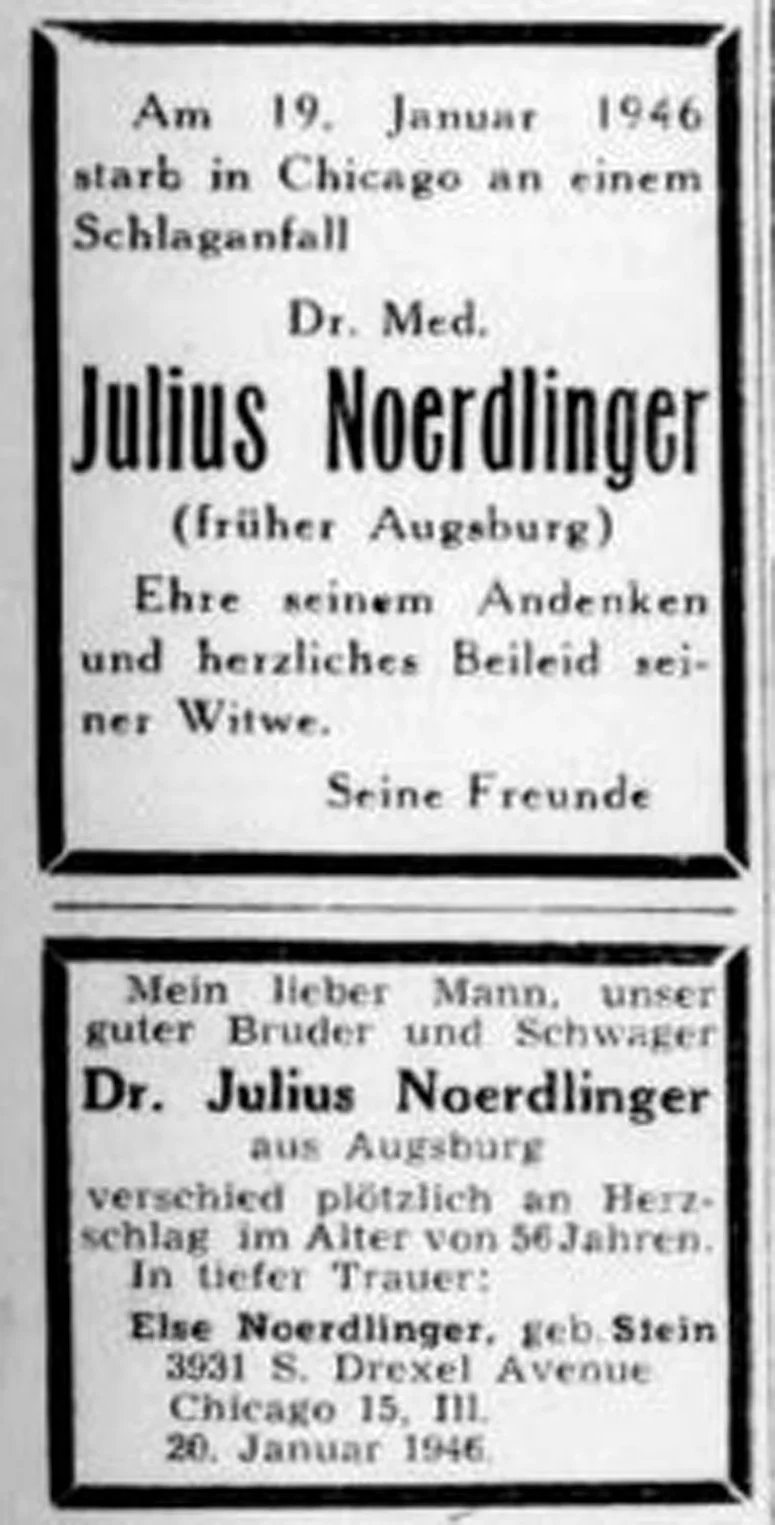
As early as 1946, Dr. Nördlinger died of a heart attack, one day after his 56th birthday. He is an example of a patriot and democrat persecuted due to his Jewish descend.
This biography is based on research by Michael Spotka in: “Benigna Schönhagen und Michael Spotka, Augsburgs jüdische Ärzte im Nationalsozialismus. Ein Stadtrundgang, Augsburg 2016" and by Elisabeth Friedrichs.
Alfred Hausmann (Translation by Michael Bernheim)
Aufbau - Reconstruction, Nr. 5 (01.02.1946).
Lutz Neumann, „Dr. med. Hermann Lemmle. Jüdische Ärzte und ihr Schicksal – ein Stadtrundgang“, in: Jüdische Allgemeine, 10.3.2011 (https://www.juedische-allgemeine.de/article/view/id/9886)
Elisabeth Friedrichs: Unveröffentlichte Aufzeichnungen zu jüdischen Ärzten in Augsburg im Nationalsozialismus, 1988.
Gernot Römer (Hg.), „An meine Gemeinde in der Zerstreuung.“ Die Rundbriefe des Augsburger Rabbiners Ernst Jacob 1941–1949 (Material zur Geschichte des Bayerischen Schwaben, Bd. 29), Augsburg 2007.
Michael Spotka, Dr. Julius Nördlinger, in: Benigna Schönhagen (Hg.): Augsburgs jüdische Ärzte im Nationalsozialismus. Ein Stadtrundgang, Augsburg 2016, S. 18-21.
Universität Würzburg (Hg.), Die geraubte Würde. Die Aberkennung des Doktorgrads an der Universität Würzburg 1933-1945. Würzburg 2011, S. 191.