
Dina Marx, née Strauß
03.02.1900, Binswangen
25.11.1941, Kaunas (Kowno), Lithuania
Residencies
Binswangen, house number 171 (today: Hauptstraße 30)
Augsburg, Schrannenstraße 6
Munich, Walhallastraße 60
Munich, Herzog-Heinrich-Straße 3
Last voluntary residence
Places of persecution
Deportation
from Munich-Milbertshofen
to Kaunas (Kowno), Lithuania
on 20 November 1941
Dina Marx was born in Binswangen on February 3, 1900 (house number 171, today Hauptstraße 30). At that time, 109 Jews lived in the village near Wertingen: 11.6% of the total residents. Dina's father Salomon Strauß dealt in grain and other agricultural crops, as well as farm equipment and supplies. He also owned a warehouse in Lauingen. Dina’s mother Betty, née Binswanger, was also from Binswangen. Dina had three older brothers: Martin (born 1886, killed in action 1918), Theodor (born 1888) and Friedrich (born 1890). Theodor died in 1941 in Fürth. Friedrich was deported to Piaski in 1942 and murdered (see biography Friedrich Strauß). The date of his death is not known.
From 1911 to 1916, Dina attended grades 1 to 5 of the Maria Theresia Gymnasium in Augsburg, which until 1914 was called the "Municipal School for Young Ladies". In 1913, her family moved to Augsburg, bought the house at Schrannenstraße 6, and ran the J.J. Straußwholesale grain business there, named after the company's founder, Solomon's father, Josef Jeremias Strauß. From 1916, Dina studied classical singing at the conservatory in Augsburg. It has been handed down that she sang at the Bat Mitzvah ceremony in the synagogue in 1935.
On June 26, 1929 in Augsburg, Dina Strauß married Leo Marx, a merchant from the Saarland who was three years her senior. The young family lived in the house at Schrannenstraße 6. Following the death of her father in 1923, Dina, her mother and her brother Theodor had inherited the house, each owning a third of the property. Dina's husband Leo worked at music stores, e.g., at Musik Durner. From 1928 to April 1934, Leo was in business for himself and ran a store in Frauentorstraßewhich sold gramophones and loudspeakers.
Leo Marx was an early victim of persecution by the National Socialists. He was imprisoned in Dachau from October 1934 to November 1935 and in Sachsenhausen from June 1938 to April 1939, a total of almost 2 years. In 1938, he was one of about 10,000 victims of the "Arbeitsscheu Reich" wave of arrests, including about 2,500 Jews. 824 of them were deported to Sachsenhausen, where they were subjected to particularly brutal harassment. Often, those arrested had refused an assigned job or had a criminal record. In the case of Leo Marx, a previous conviction for insulting someone in 1926 may have played a role. His house was forcibly sold, the proceeds put in a restricted account and his car confiscated.
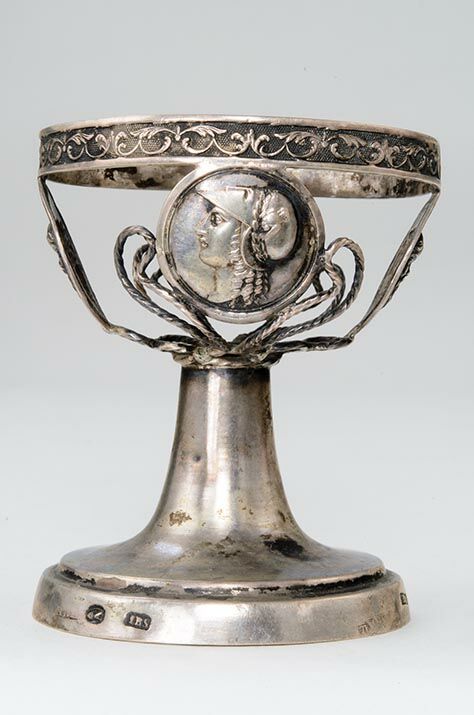
His wife was forced - probably in March 1939 - on the basis of the "Ordinance on the Registration of the Property of Jews" to hand over two silver art objects. These were a spice vessel from 1815/16 by the Augsburg silversmith Johann Balthasar Stenglin and a 16 cm high gilded goblet by an unknown Augsburg master from around 1625. The objects were valued at a material value of RM 10 and RM 15 respectively and Dina Marx was presumably compensated for them in this way. They were given to the Bavarian National Museum and are still there (as of October 2018).
After his release from the concentration camp in June 1939, Leo Marx managed to emigrate. From Bremen he arrived in Shanghai on the Lloyd steamer "Gneisenau”. This was the only destination that Jews could reach with some degree of ease, the "exile of the common people". However, the living conditions were miserable. People lived in mass quarters in a ghetto. Marx's occupation is now stated as Kapellmeister, and Tongshan Road 599 as his accommodation. It is known that a lively cultural life was developed by the Jewish emigrants. Leo Marx remained in Shanghai until 1948 and married a Korean-born Jewish woman there in 1947. In December 1948 he returned to Saarbrücken. The marriage was divorced in 1957 and Marx married the non-Jewish Erika Anita Allmann a year later. He died in Saarbrücken in 1972. Between 1956 and 1960, Leo Marx testified at the criminal trials of the Sachsenhausen murderers Gustav Sorge, Wilhelm Schubert, Otto Kaiser, and Dr. Heinz Baumkötter.
Leo's wife Dina stayed behind in Munich with the children in 1939. She was forced to move to Herzog-Heinrich-Strasse 3 and did not manage to join her husband in Shanghai. On November 20, 1941, she was deported. After a short stay in the Milbertshofenbarracks camp, which Munich Jews had been forced to build, she was deported in a three-day train ride to Kaunas in Lithuania. It was the first deportation from Bavaria. Three other former Maria Theresia students were also on that transport. After two nights in the dilapidated fortress of Fort IX, all the defenseless victims were murdered by SS Einsatzgruppe 3 in a mass shooting.
Approximately 1,000 people were transported from Munich alone. Corpses and injured were covered with dirt. Until 1944, more than 50,000 Jews were shot in the Kaunas forts. In his report on the 1941 massacre in Kaunas, the SS-Standartenführer in charge, Karl Jäger, names 1,159 Jewish men, 1,600 Jewish women and 175 Jewish children. Among the children were Gert and Joel, Dina's nine- and not yet three-year-old sons. Gert had been placed in the Jewish children's home on Antonienstrasse in October 1939. Along with him, 20 children from this home were murdered during this transport. To conceal the crimes, the Gestapo had the bodies dug up and burned and the ashes scattered. Karl Jäger lived undisturbed in freedom under his real name until 1959, when he hanged himself in custody.
Alfred Hausmann
(Translation by Cynthia Byrne)
Stadtarchiv Augsburg (StadtAA)
Hausbogen (HB):
– HB Schrannenstraße 6
Familienbogen (FB):
– FB Leo Marx, 31.07.1898
Meldekarten (MK):
– MK Leo Marx
Staatsarchiv Augsburg (StAA)
Amtsgericht Augsburg (AG Augsburg):
– AG Augsburg, Nachlassakte Salomon Strauß
Stadtarchiv München (StadtAM)
– Auskunft von Frau Barbara Hutzelmann vom 19.06.2018
Stadtarchiv Saarbrücken (StadtASB)
– Sterbeurkunde, Meldekarten, Auskunft vom 25.07.2018
Landesarchiv des Saarlandes (LandASL)
– Akten des Wiedergutmachungsverfahrens Leo Marx
Archiv der KZ-Gedenkstätte Dachau
– Auskunft Herr Pearman vom 10.07.2018
Archiv KZ-Gedenkstätte Sachsenhausen
– Auskunft vom 12.07.2018
https://www.bundesarchiv.de/gedenkbuch/directory.html.de
http://www.datenmatrix.de/projekte/hdbg/spurensuche/index_extern.html, Eintrag für Dina Strauß
http://www.muenchen.de/rathaus/gedenkbuch/gedenkbuch.html, Eintrag für Dina Marx
https://www.welt.de/print-welt/article489175/Vor-60-Jahren-begannen-die-Juden-Deportationen.html
https://de.wikipedia.org/wiki/Gustav_Sorge
https://de.wikipedia.org/wiki/Heinz_Baumk%C3%B6tter
https://de.wikipedia.org/wiki/Karl_J%C3%A4ger
www.zukunft-braucht-erinnerung.de/das-ghetto-in-kowno/
Georg Armbrüster (Hg.), Exil Shanghai, Teetz 2000.Andreas Heusler/Elisabeth Angermair, Verzogen - unbekannt wohin, Zürich-München, 2000 S. 13-24.
Andreas Heusler/Brigitte Schmidt/Eva Ohlen/Tobias Weger/Simone Dicke unter Mitarbeit von Maximilian Strnad: Biographisches Gedenkbuch der Münchner Juden 1933–1945, Bd. 2 (M–Z), hrsg. vom Stadtarchiv München, München 2007, S. 48f., 52 u. 54.
Ludwig Reissler, Geschichte und Schicksal der Juden in Binswangen in: Der Landkreis Dillingen a. d. Donau in Geschichte und Gegenwart, Dillingen 2005.
Stefanie Schüler-Springorum, Masseneinweisungen in Konzentrationslager: Aktion „Arbeitsscheu Reich“, Novemberpogrom, Aktion „Gewitter“ in: Wolfgang Benz/Barbara Distel (Hg.): Der Ort des Terrors, München, 2005, S. 156-164.
„Und keiner hat für uns Kaddisch gesagt..“ Deportationen aus Frankfurt am Main 1941 bis 1945 (Ausstellungskatalog), Frankfurt a. M., o. J.